The Internet's most
extensive collection of SPECIALTY MOTHER'S
JEWELRY
is found here! Offering over
800+ mothers
rings & family rings,
pendants,
bracelets, brooches & charms. Compare our competitive prices.
|
IMPORTANT: Most images provided in this
online store are enlarged to show detail. We often try to provide an
image that is close to actual size on a 16" diagonal monitor. However always refer to stone sizes and ring/pendant width
or other measurements provided to help determine the actual size of the
item you are considering. An inches to millimeters conversion chart is
provided below. Most rings pictured are a finger size 6 1/2 in
real life and most are set with simulated stones.
| Millimeters |
1.6mm |
2.4mm |
3.2mm |
6.4mm |
9.5mm |
12.8mm |
15.9mm |
19.1mm |
22.3mm |
25.4mm |
| Inches |
1/16" |
3/32" |
1/8" |
1/4" |
3/8" |
1/2" |
5/8" |
3/4" |
7/8" |
1" |
* Millimeter measurements are
rounded off to the nearest 10th.
IF IN DOUBT, ORDER A
SAMPLE TO VIEW PRIOR TO PURCHASE.
Genuine Stones- Each
manufacturer offers their own selection of genuine stones and the quality
offered and
pricing varies between manufacturers. Some manufacturers offer traditional birthstones while
others offer their own selection of genuine stones so it's very important that you read the
Production Information Page for each item you are considering. Each
collection is different and has it's own product information section.
Stone Information-
Information about
genuine, man-made and simulated stones.
-
What is the
TRADITIONAL birthstone for each month?
-
Alexandrite- A scarce color-change
birthstone...
-
Opals, Cultured Pearls, Moonstone, etc.
-
"Commercial
Grade"
stones... what does it mean?
-
What's the difference between genuine stones, synthetic stones, and
simulated stones?
-
Descriptions of different stones. Online color charts may not be accurate on
all computer monitors.
-
How do I properly care for specific
gemstones?
-
How big is a millimeter?
-
STONE ADDITIONS- What happens if we have a new addition to our family and we would like to
add stones in the future?
Each mfr. offers their own
selection of genuine stones. It is important that you view the stone options
for each individual item by clicking on the option boxes located on each
individual product page. Often, only one option is available for each birth
month. Before ordering, be sure you visit the Product & Stone Information
page as indicated on the order page. The stones each individual mfr.
offers are generally selected for two reasons... because of pricing (in
order to keep pricing more affordable) or because of the settings they offer
(some setting's prongs are not long enough to securely hold a cabochon-
domed without facets- like Opals or Moonstone) or a sphere like a Cultured
Pearl. Below are traditional birthstones and also other stones that some of
our mfrs. offer.
|

|
|
Month |
Traditional Stones |
What
Some Mfrs. May Offer |
| January |
Garnet |
|
| February |
Amethyst |
|
| March |
Aquamarine
Bloodstone (seldom offered) |
Sky Blue Topaz |
| April |
Diamond |
White Sapphire
White Topaz
White Zircon |
| May |
Emerald |
Green Onyx
Green Tourmaline
Green Quartz |
| June |
Alexandrite
(scarce/expensive)
Cultured Pearl
Moonstone (seldom offered) |
Smokey Quartz
Green Tourmaline
Pink Tourmaline |
| July |
Ruby |
Rhodolite
Garnet |
| August |
Peridot
Sardonyx (seldom offered) |
|
| September |
Sapphire |
Blue Spinel,
Iolite |
| October |
Pink Tourmaline
Opal |
Green
Tourmaline |
| November |
Citrine
Topaz |
|
| December |
Blue Zircon
Turquoise (seldom offered) |
Blue Topaz,
Tanzanite |
* Other stones may also be
available.
One of the most often asked
questions is about the June birthstone- Alexandrite. Genuine Alexandrite,
a color-change stone, is a scarce and expensive gemstone in a good quality.
It is only occasionally offered in mothers jewelry. As with all genuine
stones, Alexandrite comes in different qualities and price ranges that are
generally based upon the color and color-change phenomenon, the cut and
the clarity of the stone.
Because of the price and availability problems associated with genuine
Alexandrite, some
mfrs. have selected their own genuine stone to represent the month of June.
Some manufacturers use Green
Tourmaline to represent the green color of Alexandrite... another offers
Color-Change Garnet because it too changes color based upon the light source. Others offer Smokey
Quartz... and still others use Pink Tourmaline. These stones are offered by the
mfrs. to help keep the price of their products affordable. If you must
have genuine Alexandrite, we recommend the collection below. Note that
stones have only limited availability and finer qualities may also be available
(pricing is for "A Quality" Alexandrite).
|
|
Not all mfrs. offer Opals (October), Cultured Pearls, Moonstone (June), etc. in their products.
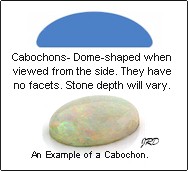
Opals are cabochon-shape stones... they are domed with no facets so when set they
look different when compared to a faceted stone when viewed from the top and the
side. The same applies to Cultured Pearls... although they are not a cabochon shape
stone, they have no facets. Many mfrs. do not offer Cultured Pearls because the prongs of their
settings are not long enough to securely hold them in place. Below
are some manufacturers that offer either Cultured Pearls or Opals...
Turquoise, Moonstone and Bloodstone are seldom
offered in mother's jewelry.
|
"Commercial Grade" means a lower
quality of genuine stone which is most noticeable in Emeralds, Rubies and
Sapphires. Other stones tend to be more acceptable in their appearance. We offer a few collections that only offer
commercial quality stones and the ratings we give them is usually a 3 (+/-) heart
rating.
Two
important things determine a commercial grade stone...
Color: Emeralds may be very pale or very dark. Rubies may be
pinkish to purplish red. Sapphires are usually "inky" or very dark blue/black
with no royal blue flash.
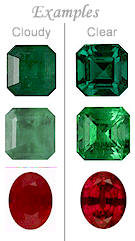
Inclusions: Most commercial stones will have numerous inclusions
that prohibit light from traveling past the table or top of the stone.
Only the top facets of the stone may reflect light so the stone appears "cloudy"
with little sparkle.
|
|
Inclusions are a natural
occurrence in genuine stones but especially noted in Emeralds. You will
find inclusions in most genuine stones. We do not offer eye-clean stones,
stones with no eye visible inclusions, like those shown on the "clear" side of
the picture on the left. When searching for the mother's
jewelry collection that is right for you, you want to find a balance between
price and eye-visible inclusions (meaning inclusions visible with the naked eye
or without any magnification). When you have a stone that has fewer
inclusions, light is able to pass through the table of the stone to reflect off
the facets inside the stone. It gives the stone more depth and sparkle.
With Commercial Quality or Commercial Grade stones, the light may only reflect
off the top of the stone or there may be numerous inclusions that make the stone
completely impenetrable by light.
For the
best quality emeralds and rubies that we offer, we recommend
collections with a
5 heart rating and look for stone qualities finer than "A".
Good qualities are also found in collections with 4 heart
ratings. Stones
will still have inclusions however they will have a better overall appearance.
|
Genuine Stones: Genuine stones come from the earth and have been
created by God/Nature. Many genuine stones are commonly
treated by man to either
bring about or enhance their beauty. Some stones are rather unattractive
until they have been treated.
Synthetic Stones: Synthetic stones are man-made or created stones that
have approximately the same chemical and physical characteristics of genuine
stones. They are created in a laboratory by man.
Simulated Stones: These are stones that only look similar to a genuine
stone... they imitate a genuine stone. Note that simulated stones seldom
look the same as genuine stones.
The type of gemstones you have
or select determines the care they require. Some genuine stones have excellent
durability while others require you to be more careful when wearing them.
For instance rubies and sapphires are considered an excellent choice for
everyday wear while an opal or pearl require extra careful handling. This
is NOT to say that you can be rough or abusive with your jewelry. You can
break any stone including a diamond. It simply means that some gemstones
are more durable than others. For a list of details about several
varieties of genuine stones, please visit one of our manufacturer's websites at
Below are some general
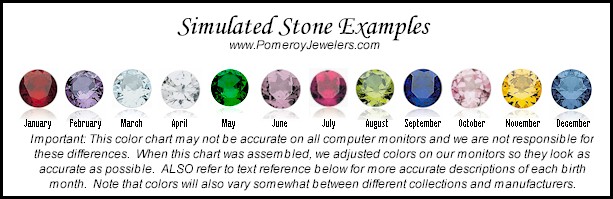
color descriptions for simulated stones. These are
only approximate color descriptions. This online color
chart may not be accurate on your computer monitor due to individual
monitor settings. What looks right on our
computers may not look right on yours. Note that simulated stones look
different compared to genuine stones used for the same months.
|
Simulated Stones |
General Color Description |
|
January |
Red (usually a
bit darker than July) |
|
February |
Purple |
|
March |
Pale Blue |
|
April |
Clear/White |
|
May |
Green |
|
June |
Pale Purple to
Gray |
|
July |
Red/Pink |
|
August |
Yellow/Green |
|
September |
Royal Blue |
|
October |
Light Pink |
|
November |
Yellow |
|
December |
Medium Blue |
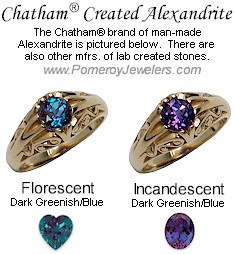
Chatham® Lab Created Stones- Stones that are made by man. Other "brands"
of lab created stones from other manufacturer's may look similar. Look for this name when ordering... not offered unless
specifically indicated. These stones have about the same chemical make up of the
genuine stone however they are made in a lab by man. They are much more
expensive than the simulated stones above.
These are only approximate color descriptions. This online colors may
not be accurate on your computer monitor due to individual monitor settings.
What looks right on our computers may not look right on yours.
|
Actual colors will
vary because of image reproduction and differences in computer monitors. |
Chatham®
Created
(Man-Made/Lab) Stones
(Look for the Chatham name) |
General Color Description
of Chatham®
Created Stones |
Gem Quality Pictured |
Chatham® Created
Alexandrite
-
RI: 1.746-1.755
-
Hardness: 8.5
-
Specific Gravity:
3.73
-
Species: Chrysoberyl
-
Optic Character: DR
-
Phenomena: Color
Change
|
Gem: Eye clean to
very minimal eye visible inclusions; medium to dark greenish blue changing
to purple.
Our
Observations: Under florescent lighting it's more of a deep
green/blue... a deep teal color. Under incandescent lighting (a
standard light bulb) it's more purple with some reddish purple. |

Gem Quality Pictured |
Chatham® Created Ruby
-
RI: 1.762-1.770
-
Hardness: 9
-
Specific Gravity: 4
-
Species: Synthetic
Corrundum
-
Optic Character:
-
Phenomena: Asterism
|
Gem: No eye
visible inclusions; medium to dark
Fine: Minimal
eye-visible inclusions; medium to dark blood red; good cut |

Gem Quality Pictured |
Chatham® Created Emerald
-
RI: 1.577-1.583
-
Hardness: 7.5-8
-
Specific Gravity:
2.72
-
Species: Beryl
-
Optic Character: DR
-
Phenomena:
|
Fine: Minimal
eye-visible inclusions; medium to dark green; good cut
Gem: No eye
visible inclusions; medium to dark |
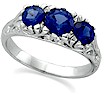
Gem Quality Pictured |
Chatham® Created Sapphire
-
RI: 1.762-1.770
-
Hardness: 9
-
Specific Gravity: 4
-
Species: Synthetic
Corrundum
-
Optic Character: DR
-
Phenomena: Asterism
|
Gem: Very minimal
eye visible inclusions; medium to dark blue |
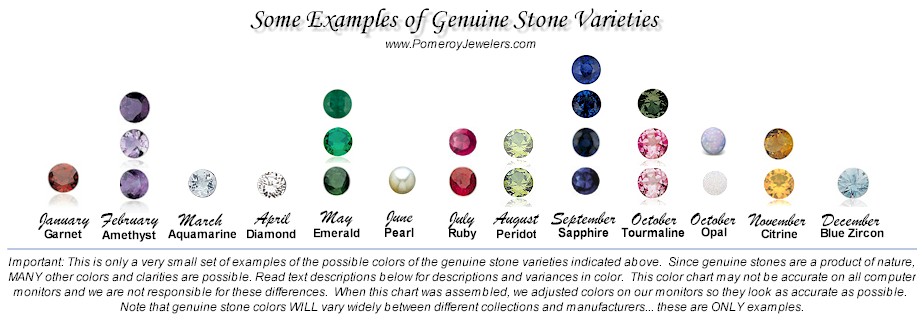
Below are some general
color descriptions for genuine stones.
Genuine stones, being a product of nature, will vary even within the same
mfr. These are
only approximate color descriptions. This online color
chart may not be accurate on your computer monitor due to individual
monitor settings. What looks right on our
computers may not look right on yours. Color ranges are provided
below. Not all stones shown are available in all settings.
Click here for common genuine stone treatments.
|
Genuine Stone |
Color Range |
| Genuine
Alexandrite |
A color change
gemstone that is scarce and expensive in a good quality. Note that genuine
Alexandrite may also have other colors depending upon the origin of the
stone. Greenish
Blue
to Reddish-Violet color change stone... better grades have good color and good color
change. Lower qualities are available (more cloudy with some color
change). Good stones are scarce and more expensive.
Only ONE collection currently
offers this limited availability birthstone.
AB Quality: Fractures break
the surface; varies in color and clarity.
A Quality: Included,
light green/greenish blue, weak/low color change.
AA Quality: Slightly included, green/greenish blue, moderate/medium color
change.
AAA Quality: Eye clean, deep green/bluish green, bright to high color change. |
|
| Amethyst |
Light to
medium/dark purple |
| Aquamarine |
Very pale
blue to light blue |
| Citrine |
Yellow to
golden
orange/yellow |
Diamond, White
Sapphire,
White Topaz, White Zircon |
Clear/white |
| Emerald |
Light to
medium/dark green, moderate to slightly included
depending upon collection. Commercial grade emeralds
are usually very included (cloudy). |
| Mozambique Garnet |
Orange/brown to
red/orange/brown |
| Rhodolite Garnet |
Medium to
dark
pink/purple to raspberry |
| Color-Change
Garnet |
Very slightly
grayish green, moderate
color change to reddish purple. |
| Iolite |
Pale to medium
grayish purple |
| Opal |
A cabochon- domed
with no facets. Looks different when
viewed from the side when set
next to a faceted stone.
Generally white background with some red,
blue and/or
green accents. Commercial stones have less color. |
| Cultured Pearl |
White to
cream.
Sphere/ball shape or sometimes
with a flat back.
Only available in a round
shape-
other shapes are not available. |
| Peridot |
Light to
medium
yellowish green |
| Smoky Quartz |
|
Light tan to
medium/dark brown.
Example shown on right. |
 |
|
| Ruby |
Medium
red/pink to red. Commercial
stones are usually very included (cloudy) |
| Sapphire |
Medium to
dark
navy blue to royal blue |
| Blue Topaz |
Sky Blue
Topaz- Light blue
Swiss Blue Topaz- Vivid medium blue
London Blue Topaz- Muted darker blue |
| Pink Tourmaline |
Light to
medium
pink |
| Green Tourmaline |
Medium to
dark
olive green |
| Tanzanite |
Light to
medium/dark bluish purple |
| Blue Zircon |
Light to
medium
blue
(sometimes very similar to Aquamarine) |
IMPORTANT: Some of our manufacturer's do NOT
offer a stone
addition or trade-in option! Be sure to visit and read the
"Product Information Page" located on each individual product page.
|
|
Many of our mother's and family rings,
pendants, etc. can have stones "added" at a later date for an additional charge
plus shipping as long as the design is still available. Contact us for
current pricing for this service- include style number, whether genuine or
simulated stones are set, the number of stones in the ring you currently have and the new stone addition(s) required.
Your existing
ring is most often traded in for a new one with the new stone additions... you do
not get your old ring back. One exception is the Original Mother's Ring®... this
ring usually has new heads soldered in place for the new stone additions (note that
existing stones must usually be removed and reset except for diamonds, rubies or
sapphires because they will not take the heat. See each product page for
the maximum number of stones possible for that particular style.
Note that the Original Mother's Ring
is more expensive to add new stones to... this is one ring where the original
setting is usually returned with new stones added. See
the product information page for The Original Mother's ring for important
details before ordering.
Many pictures are enlarged to
show the detail of our products. Below are some approximate
"millimeter to inches" conversions for stones and ring settings that should
help you to visualize millimeter sizes. Stone sizes are generally
provided either on the product or index pages. Almost all of these rings
are made to accept only the specified stone size(s).
| Millimeters |
1.6mm |
2.4mm |
3.2mm |
6.4mm |
9.5mm |
12.8mm |
15.9mm |
19.1mm |
22.3mm |
25.4mm |
| Inches |
1/16" |
3/32" |
1/8" |
1/4" |
3/8" |
1/2" |
5/8" |
3/4" |
7/8" |
1" |
* Millimeter measurements are
rounded off to the nearest 10th.
For question that is not
addressed here...
We are here to serve you.
Please don't hesitate to contact us if you have any questions or if we can be
of service to you. We will be happy to help. Be sure to see our "Store
Policies" for more information. Please
visit this link for our contact information.
Copyright 2003-12 J. Dunne.
ALL RIGHTS RESERVED. Copying from this web site is a violation of copyright
law. Our pictures and content are for viewing only at this address and
remain our property. They may NOT be copied, reproduced or modified in any
form or manner.
Use of this web site constitutes your agreement to our online
store policies and terms.
You must be at least 18 years of age to order from this store. We reserve the right to correct errors. Many of the items and designs are also copyrighted. Orders must be placed through our website- orders placed through cached browser
or cached search pages will NOT be honored.

Presented by
Pomeroy Jewelers - 3946
Park Lane - Traverse City, Michigan 49686 - Telephone: (231) 938-2582
https://www.MomsJewelryBox.com
Contact Us-
https://www.momsjewelrybox.com/contact-us.htm
Specialty Mothers Rings and Jewelry
Items-
hundreds of keepsakes just for mom .
|